

Russian strikes on civilian vessels near Ukrainian ports have virtually paralyzed maritime exports, so prices in ports continue to fall
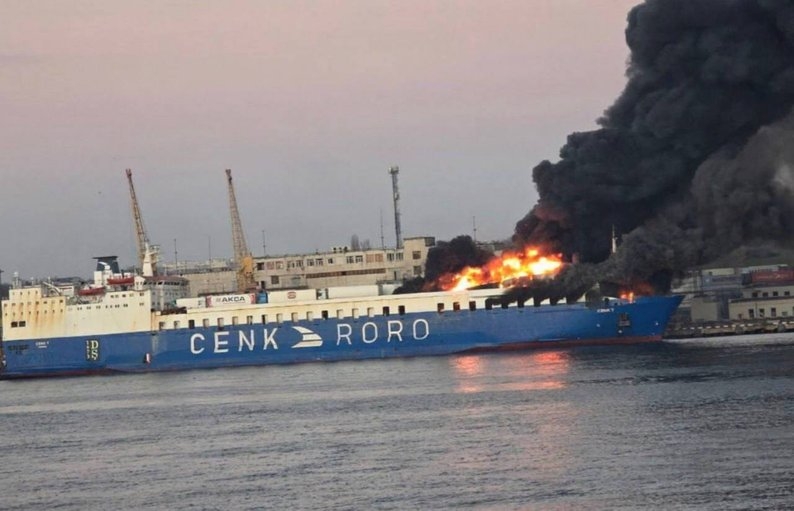
Russian aggressors intensified attacks on civilian merchant vessels under Ukrainian and foreign flags near the ports of the Odessa region, switching from drone strikes (which hit 1-2 vessels daily) to the use of anti-ship missiles, as a result of which shipowners began to refuse to submit vessels for loading.
According to the Ukrainian Navy and the Odessa Naval Base, on July 19, the enemy launched three Kh-59/69 cruise missiles at the Turkish-owned civilian merchant vessel Golden Leo, flying the flag of Guinea-Bissau. The attack killed at least 10 sailors.
On the evening of July 21, in the international waters of the Black Sea (~20 nautical miles from the coast of Romania), the LPG Gas Lisbon gas tanker under the Liberian flag, which was heading from the port of Alexandria (Egypt) to the Ukrainian port of Reni on the Danube (Odesa region) with a cargo of 3,790 tons of propane, was attacked, resulting in a fire, but the crew was rescued.
All international traders have practically stopped accepting and purchasing grain in Black Sea ports, and only a small part continues purchasing, while reducing prices due to the increase in freight costs and insurance against the risks of loss of ship cargo and damage to terminals.
During the week, purchase prices with delivery to Black Sea ports fell by 1000-1500 UAH/t from 10200-10300 UAH/t to 9000-9500 UAH/t for food wheat, from 9700-9900 UAH/t to 8000-8500 UAH/t for feed wheat, and from 9000-9400 UAH/t to 8000-8500 UAH/t for barley.
At the same time, traders began to more actively use alternative routes developed in 2022 and 2023 (via Danube ports and the western border).
Currently, purchase prices with delivery to Danube ports are 9250-9400 UAH/t for food wheat, 8500-8800 UAH/t for feed wheat, and 8100-8200 UAH/t for barley.
The potential logistical throughput capacity across the western border is currently estimated at 4.4 million tons per month, so traders will quickly solve the problem with supplies to the EU, where prices have risen sharply due to restrictions on exports from the Black Sea, which compensates for additional logistical losses.
The increase in demand has already led to an increase in the cost of barge freight from Ukrainian Danube ports to Constanta from $12/t to $30/t. Low water levels in the Danube will also slow down deliveries and port operations, so traders will focus on rail deliveries to the port of Constanta.
At the same time, it should be noted that the main difference from 2022 lies in the financial condition of farmers, who received a large credit resource from the state and had fairly high prices and good incomes in the last two years, therefore they have more opportunities to store grain and restrain sales, not agreeing to sell at any price.
The Ministry of Agrarian Policy, chaired by the Minister of Agrarian Policy and Food of Ukraine Taras Vysotsky, held a meeting with agrarian business, insurance companies, and relevant government bodies on additional mechanisms to protect port logistics and agricultural products from war risks and create effective tools that will help enterprises compensate for losses from war risks, reduce insurance costs, and ensure the uninterrupted operation of maritime logistics and exports.
