

Satellite data over 22 years confirms the scale of the water crisis in Europe, including Ukraine
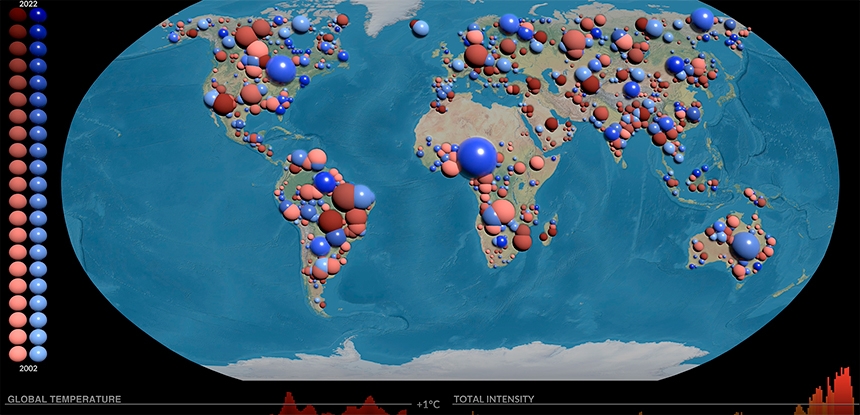
A new study by University College London (UCL), conducted in collaboration with Watershed Investigations and The Guardian, based on 22 years of gravity measurements, shows a decline in freshwater supplies in Europe , including Ukraine.
The technology of "weighing" water by satellites has allowed scientists to identify the process of systemic losses of fresh water in Europe, not only surface water, but also in underground aquifers, which were previously considered a stable reserve.
Scientists analyzed data from the GRACE (Gravity Recovery and Climate Experiment) satellite mission and its successor GRACE-FO for the years 2002–2024. The measurement principle is based on physical laws: water has a significant mass, which affects the Earth's gravitational field. The satellites record fluctuations caused by changes in the amount of water in underground horizons, rivers, lakes, soil moisture and glaciers.
The study revealed a clear geographical pattern – two zones formed in Europe:
- drying (decrease in humidity) – which includes Spain, Italy, France, Switzerland, Germany, Romania, Ukraine, South-East England,
- increased humidity – Scandinavia, part of Great Britain, Portugal.

A separate question was whether the decrease in water quantity only concerns surface waters – rivers and lakes? The study showed that groundwater volumes are also decreasing.
From the total array of measurements, data on groundwater were isolated, which was traditionally considered a "buffer" that smoothes out seasonal fluctuations and droughts.
The results showed that their reserves are being depleted across southern and central Europe, repeating a general trend, despite the fact that total precipitation may remain stable or even increase.
The reason is a change in the nature of rainfall - heavy downpours and longer dry periods, especially in summer. Intense precipitation flows over the earth's surface, causing floods, but does not have time to seep into the aquifers. At the same time, the winter groundwater recharge season is shortened.
Official data on water consumption in the EU show a decline in consumption and increasing pressure. According to the European Environment Agency, total water abstraction in the EU decreased between 2000 and 2022, but groundwater extraction increased by 6%.
The volume of public water supply increased by 18%, and for use in agricultural production by 17%. In 2022, groundwater provided 62% of public water supply in EU countries and 33% of the needs of the agricultural sector.
The increasing demand for groundwater, coupled with its decreasing volume, has led the European Commission to develop an EU Water Sustainability Strategy aimed at helping EU Member States adapt water management to climate change and anthropogenic pressures.
The key objectives of the strategy are:
- Increasing water efficiency by at least 10% by 2030.
- Reduction of losses in networks.
- Infrastructure modernization.
The level of leakage in water supply networks in EU countries ranges from 8% to 57%, indicating the scale of the problem and significant potential for improvement.
However, some experts are skeptical of such measures, including the UK government's plans to build nine new reservoirs that will not be operational for several decades and therefore will not be able to solve the problem quickly.
Therefore, they propose alternative approaches:
- Water reuse with closed consumption cycles.
- Reducing consumption.
- Separation of drinking and process water.
- Restoring wetlands that retain moisture.
- Review of approaches to development taking into account the water balance.
Ukraine is also among the countries where a reduction in water resources has been recorded. But here, climatic factors are superimposed on unprecedented military destruction of infrastructure.
According to UNICEF (as of 2023), almost 10 million people in Ukraine, including 1.7 million children, do not have access to safe water services, and only 68% of the population has access to centralized water supply (97% in cities and 26% in villages).
A third of drinking water samples do not meet national standards, while in Germany this figure is only 0.1%.
June 2023, when the Kakhovka hydroelectric power station was destroyed, was a turning point for the water security of southern Ukraine. According to a scientific article in ScienceDirect and a UN report, this had the following consequences:
- Ukraine lost 10% of its water resources,
- 6 million people lost access to quality drinking water,
- over 13 million people (a quarter of the country!) have limited access to water for sanitation and hygiene needs.
Total damage and losses are estimated at $14 billion.
A separate problem is the energy consumption of Ukrainian water supply systems, which, according to UNICEF, consume 1.01 kWh/m³ of energy, while the European standard is 0.5-0.7 kWh/m³. This difference makes the water supply very vulnerable, especially given the constant shelling of energy infrastructure.
According to the UNFCCC, Ukraine is vulnerable to droughts and floods, which lead to significant economic losses. Agriculture, industry, and households in the south and southeast are very vulnerable to current and projected droughts. And the war has accelerated what climate models predicted only for 2050.
